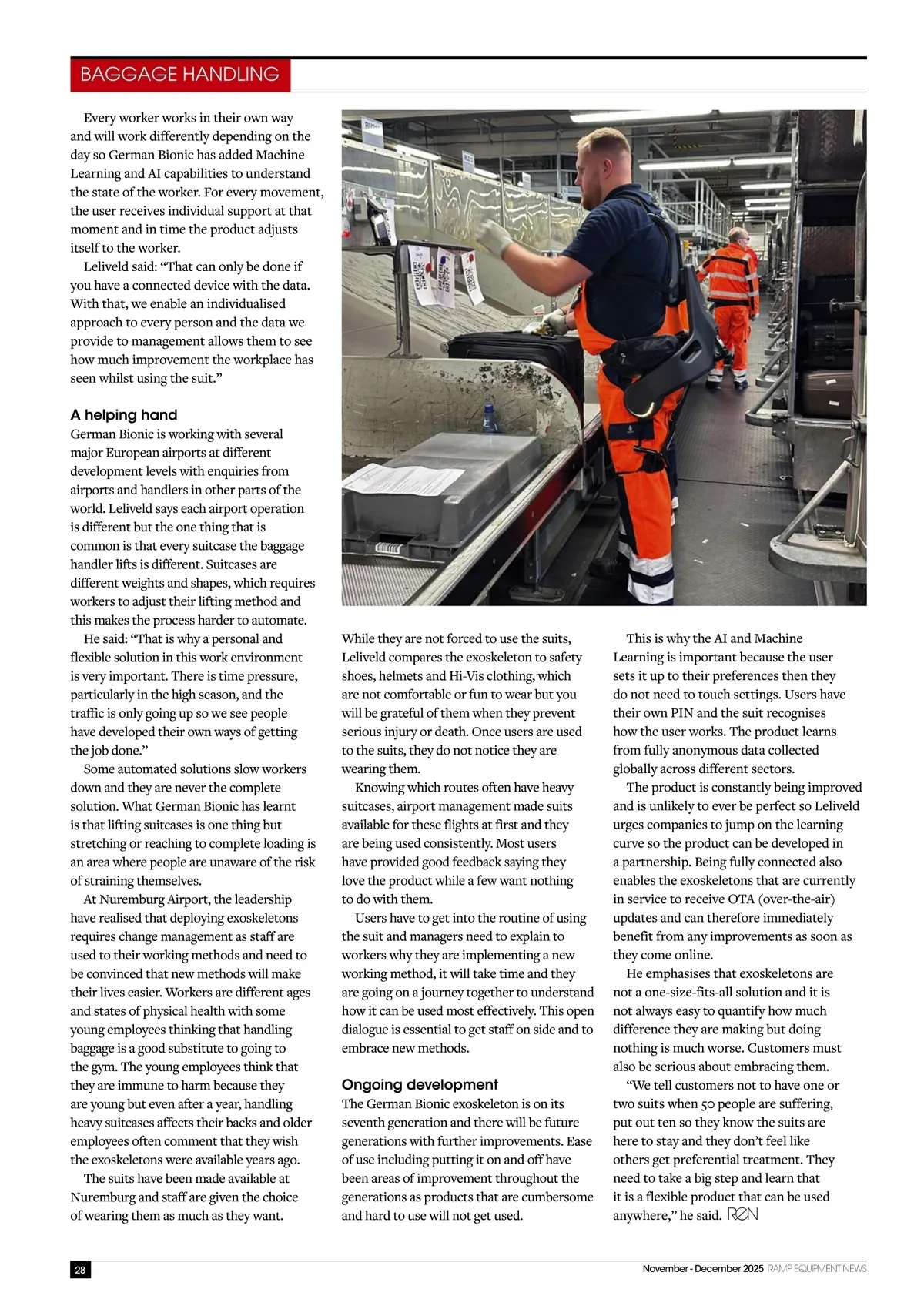
BAGGAGE HANDLING Every worker works in their own way and will work differently depending on the day so German Bionic has added Machine Learning and AI capabilities to understand the state of the worker. For every movement, the user receives individual support at that moment and in time the product adjusts itself to the worker. Leliveld said: “That can only be done if you have a connected device with the data. With that, we enable an individualised approach to every person and the data we provide to management allows them to see how much improvement the workplace has seen whilst using the suit.” A helping hand German Bionic is working with several major European airports at different development levels with enquiries from airports and handlers in other parts of the world. Leliveld says each airport operation is different but the one thing that is common is that every suitcase the baggage handler lifts is different. Suitcases are different weights and shapes, which requires workers to adjust their lifting method and this makes the process harder to automate. He said: “That is why a personal and flexible solution in this work environment is very important. There is time pressure, particularly in the high season, and the traffic is only going up so we see people have developed their own ways of getting the job done.” Some automated solutions slow workers down and they are never the complete solution. What German Bionic has learnt is that lifting suitcases is one thing but stretching or reaching to complete loading is an area where people are unaware of the risk of straining themselves. At Nuremburg Airport, the leadership have realised that deploying exoskeletons requires change management as staff are used to their working methods and need to be convinced that new methods will make their lives easier. Workers are different ages and states of physical health with some young employees thinking that handling baggage is a good substitute to going to the gym. The young employees think that they are immune to harm because they are young but even after a year, handling heavy suitcases affects their backs and older employees often comment that they wish the exoskeletons were available years ago. The suits have been made available at Nuremburg and staff are given the choice of wearing them as much as they want. While they are not forced to use the suits, Leliveld compares the exoskeleton to safety shoes, helmets and Hi-Vis clothing, which are not comfortable or fun to wear but you will be grateful of them when they prevent serious injury or death. Once users are used to the suits, they do not notice they are wearing them. Knowing which routes often have heavy suitcases, airport management made suits available for these flights at first and they are being used consistently. Most users have provided good feedback saying they love the product while a few want nothing to do with them. Users have to get into the routine of using the suit and managers need to explain to workers why they are implementing a new working method, it will take time and they are going on a journey together to understand how it can be used most effectively. This open dialogue is essential to get staff on side and to embrace new methods. Ongoing development The German Bionic exoskeleton is on its seventh generation and there will be future generations with further improvements. Ease of use including putting it on and off have been areas of improvement throughout the generations as products that are cumbersome and hard to use will not get used. This is why the AI and Machine Learning is important because the user sets it up to their preferences then they do not need to touch settings. Users have their own PIN and the suit recognises how the user works. The product learns from fully anonymous data collected globally across different sectors. The product is constantly being improved and is unlikely to ever be perfect so Leliveld urges companies to jump on the learning curve so the product can be developed in a partnership. Being fully connected also enables the exoskeletons that are currently in service to receive OTA (over-the-air) updates and can therefore immediately benefit from any improvements as soon as they come online. He emphasises that exoskeletons are not a one-size-fits-all solution and it is not always easy to quantify how much difference they are making but doing nothing is much worse. Customers must also be serious about embracing them. “We tell customers not to have one or two suits when 50 people are suffering, put out ten so they know the suits are here to stay and they don’t feel like others get preferential treatment. They need to take a big step and learn that it is a flexible product that can be used anywhere,” he said. 28 November -December 2025 RAMP EQUIPMENT NEWS
Ramp Equipment News November/December 2025: Page 28